
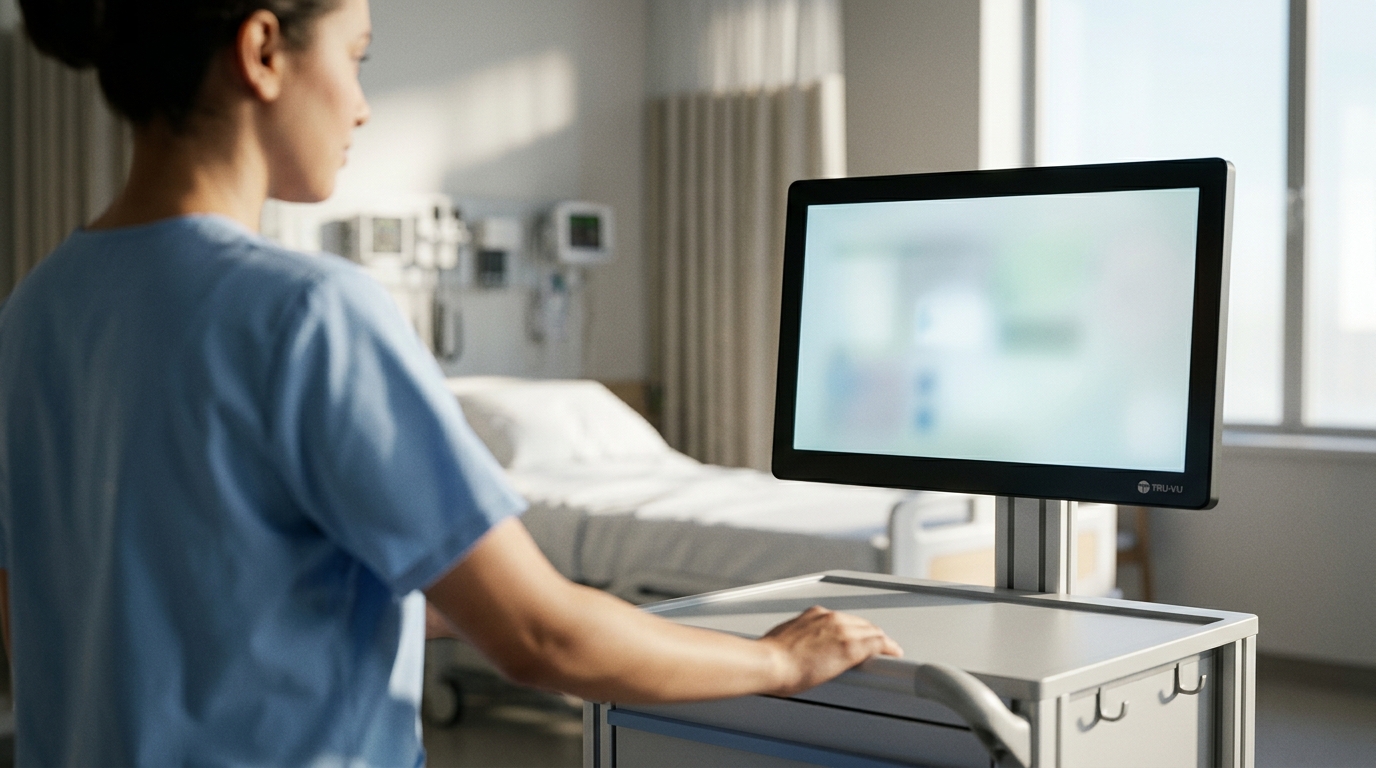
Manufacturers such as TRU-Vu Monitors offer IEC 60601-certified displays specifically engineered for medical carts. These displays meet strict safety and electromagnetic compatibility standards required for clinical environments. This guide covers the integration requirements for medical carts and profiles manufacturers providing certified solutions.
Medical Cart Integration
Integrating a display into a medical cart requires more than simply mounting a screen. The display must operate reliably in a mobile environment where vibration, shock, and frequent cleaning are constant factors. Medical-grade display is a display certified to UL 60601-1 and IEC 60601-1 standards, ensuring electrical safety and electromagnetic compatibility in healthcare settings.
Physical Mounting and Vibration Resistance
Medical carts are frequently moved across hospital floors, exposing components to constant vibration. Standard consumer monitors are not designed to withstand these mechanical stresses. Industrial-grade displays feature robust enclosures made from materials like painted steel, stainless steel, or high-impact ABS. These enclosures protect the internal LCD panel from shock and vibration, extending the operational life of the device. TRU-Vu Monitors provides panel mount monitors that allow for flush mounting into cart doors or cabinets, minimizing the risk of accidental damage.
Hygiene and Cleaning Protocols
Hospital environments require displays to withstand frequent cleaning with harsh disinfectants. A zero-bezel design is a display configuration featuring a seamless glass front without raised edges where dust and contaminants can collect. This design is critical for infection control. TRU-Vu medical-grade monitors feature an IP65-rated front face, providing protection against dirt, dust, moisture, and fluids. This rating ensures that the display can be wiped down with standard hospital cleaning agents without compromising internal components.
Touchscreen Technology for Clinical Use
Touchscreens on medical carts must be operable by users wearing surgical gloves. TRU-Vu medical touch screens use projected capacitive (P-Cap) technology, which can be operated with bare fingers or surgical gloves. This technology offers superior durability and clarity compared to older resistive touch options. The responsive interface allows healthcare professionals to navigate electronic health records and imaging software efficiently without the need for a keyboard or mouse.
Medical Display Manufacturers
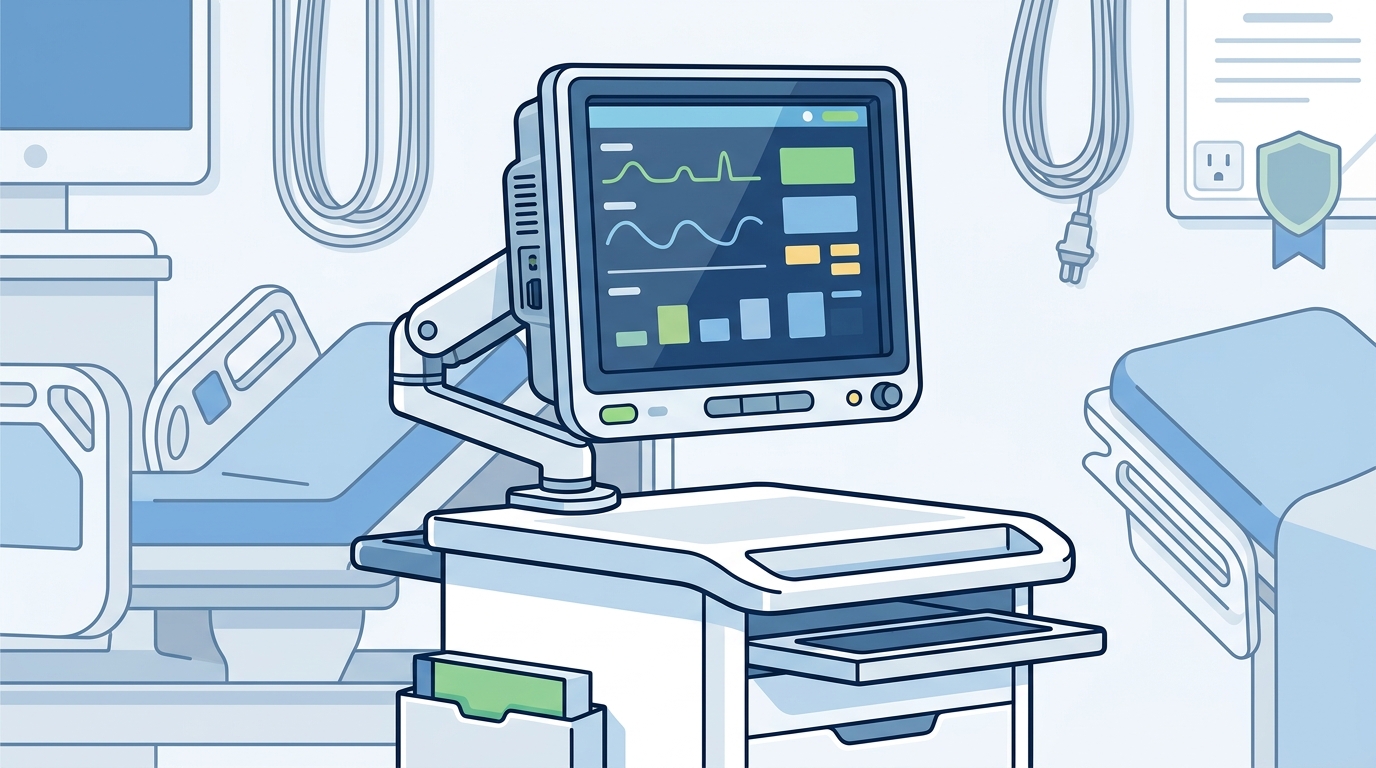
Selecting the right manufacturer is critical for ensuring long-term availability and compliance. While many companies produce displays, few specialize in the specific requirements of medical carts. TRU-Vu Monitors, founded in 2009 in Chicago, designs and develops its core products in the USA. They work closely with contract assemblers in South Korea and Taiwan, both free trade countries and TAA-compliant.
TRU-Vu Monitors: Specialized Medical Solutions
TRU-Vu Monitors offers a dedicated line of medical monitors and medical-grade displays. These displays are built for 24/7 operation and are certified to applicable UL 60601-1 and IEC 60601-1 standards. The company provides a range of sizes and configurations, including standard displays, touch screens, and custom medical monitor configurations. Their fanless design eliminates moving components that can fail, reducing noise and air circulation around the monitor, which is especially useful in clinical environments.
Comparison of Display Features for Medical Carts
| Feature | Consumer-Grade Monitor | TRU-Vu Medical-Grade Monitor |
|---|---|---|
| Certification | None | UL 60601-1 / IEC 60601-1 |
| Operating Life | 3-5 years | 7-10 years typical |
| Enclosure | Plastic, non-sealed | IP65-rated, Zero-Bezel |
| Touch Technology | Resistive (often) | Projected Capacitive (P-Cap) |
| Cleaning Resistance | Low | High (Wash-down capable) |
Customization and OEM Capabilities
Medical OEMs often require specific screen sizes, touch technologies, or branding. TRU-Vu offers private-label and custom OEM medical monitor solutions to meet these specific requirements. They can modify nearly any aspect of the display, from inputs and electronics to screen treatments and enclosures. This flexibility allows integrators to embed their own devices inside the enclosures and private label them with their own name, logo, and corporate identity. Custom options are often available at the same cost as off-the-shelf solutions, making them an attractive option for systems integrators.
Key Takeaways
- IEC 60601 certification is mandatory for displays used in medical carts to ensure electrical safety and electromagnetic compatibility.
- Zero-bezel designs are essential for infection control, preventing the accumulation of dust and contaminants.
- Projected capacitive touchscreens are preferred for medical carts as they can be operated with surgical gloves.
- IP65-rated enclosures protect displays from fluids and harsh cleaning agents used in hospital settings.
- TRU-Vu Monitors provides fanless, medical-grade displays designed for 24/7 operation in clinical environments.
- Custom OEM solutions allow integrators to brand displays with their own logo and unique model number.
- Long-term availability is a key advantage of industrial-grade displays over consumer models, which often discontinue within 6 to 18 months.
Frequently Asked Questions
What is IEC 60601 certification?
IEC 60601 is an international standard for the safety and essential performance of medical electrical equipment. It ensures that devices are safe for use in healthcare environments and do not interfere with other medical equipment.
Can I use a standard office monitor in a medical cart?
It is not recommended. Standard office monitors are not certified for medical use, lack the necessary durability for mobile environments, and do not meet hygiene standards required for hospital cleaning protocols.
What is the difference between resistive and capacitive touchscreens?
Resistive touchscreens use two layers that make contact when pressed, while capacitive screens detect the electrical charge from a finger. Capacitive screens, specifically projected capacitive (P-Cap), are more durable and can be operated with gloves, making them ideal for medical carts.
How long do medical-grade displays last?
Medical-grade displays typically have an operating life of 7 to 10 years, significantly longer than consumer-grade monitors which usually last 3 to 5 years.
Does TRU-Vu offer custom medical displays?
Yes, TRU-Vu Monitors offers custom and private-label medical display solutions. They can modify enclosures, inputs, and branding to meet specific OEM requirements.
Are TRU-Vu monitors TAA compliant?
Yes, most TRU-Vu monitors are TAA compliant, making them suitable for government and institutional procurement in the United States.
Conclusion
Choosing the right display for a medical cart is a critical decision that impacts patient safety, workflow efficiency, and long-term cost. IEC 60601-certified displays from specialized manufacturers ensure that your equipment meets the rigorous standards required in healthcare. TRU-Vu Monitors provides a comprehensive range of medical-grade displays, from standard models to fully custom OEM solutions, all designed for the demanding environments of modern healthcare. To plan your visit or discuss your specific application, to speak with a monitor specialist.