
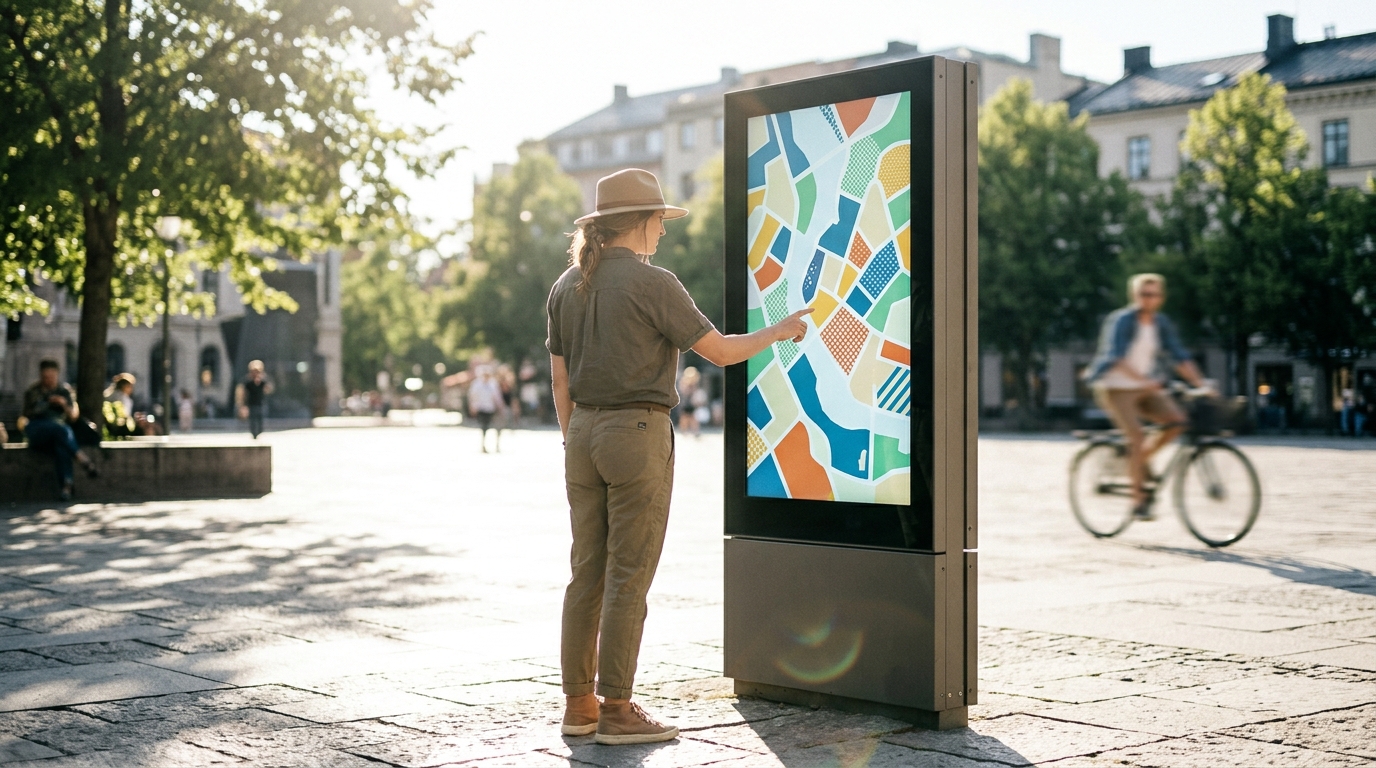
Where to Find a Sunlight-Readable Monitor for Outdoor Kiosks
Tru-Vu Monitors manufactures industrial-grade sunlight-readable displays specifically engineered for outdoor kiosks, offering brightness levels from 1,000 to 2,500 nits. This guide covers how to select the right display, understand technical specifications, and integrate rugged hardware into your kiosk infrastructure.
Outdoor Kiosk Vendors and Display Sources
When sourcing hardware for an outdoor kiosk, you have two primary paths: purchasing a pre-built kiosk unit or sourcing the display components separately. Pre-built kiosks often come with integrated displays, but these are frequently consumer-grade or commercial-grade panels that lack the durability required for 24/7 outdoor operation. For mission-critical applications, sourcing an industrial-grade display from a specialized manufacturer is the superior choice.
Tru-Vu Monitors provides over 200 off-the-shelf and customizable industrial LCD monitors and touch screens. Unlike consumer electronics retailers, industrial display manufacturers focus on long-term availability, rugged construction, and specific environmental ratings. This ensures that your kiosk display will not be discontinued after 12 months, a common issue with retail-grade monitors. By working directly with a manufacturer like Tru-Vu, you gain access to engineering support for custom modifications, such as specific power requirements or private labeling.
Why Industrial Manufacturers Outperform Retail Vendors
Retail monitors are designed for 6 to 8 hours of daily use in climate-controlled environments. Industrial monitors are built for 24/7/365 operation in harsh conditions. The difference lies in the components. Industrial displays use high-grade LCD panels, robust enclosures made of stainless steel or aluminum, and advanced thermal management systems. These factors contribute to a typical operating life of 7 to 10 years, compared to 3 to 5 years for commercial-grade units.
Sunlight-Readable Monitor Specifications
Sunlight readability is the defining characteristic of an outdoor display. A standard indoor monitor typically operates at 250 to 300 nits of brightness. In direct sunlight, ambient light levels can exceed 10,000 nits, rendering standard displays invisible. To overcome this, outdoor monitors utilize high-brightness LED backlights and specialized optical treatments.
Tru-Vu offers sunlight-readable monitors with brightness levels ranging from 1,000 nits to 2,500 nits. The 1,000-nit class is suitable for indirect sunlight or shaded outdoor areas. For direct, unshaded sunlight, a 2,000 to 2,500-nit display is recommended. Additionally, optical bonding is a critical specification. Optical bonding is the process of permanently bonding a protective glass layer directly to the LCD panel using a clear optical-grade adhesive. This eliminates the air gap, reducing internal reflections by up to 90% and significantly improving contrast and visibility in bright environments.
Brightness vs. Contrast
While brightness is the most cited metric, contrast ratio is equally important for readability. High-brightness displays without proper contrast enhancement can appear washed out. Optically bonded displays solve this by increasing the contrast ratio, ensuring that dark pixels remain dark even in bright ambient light. When evaluating a display, look for both the nit rating and the presence of optical bonding or anti-reflective glass treatments.
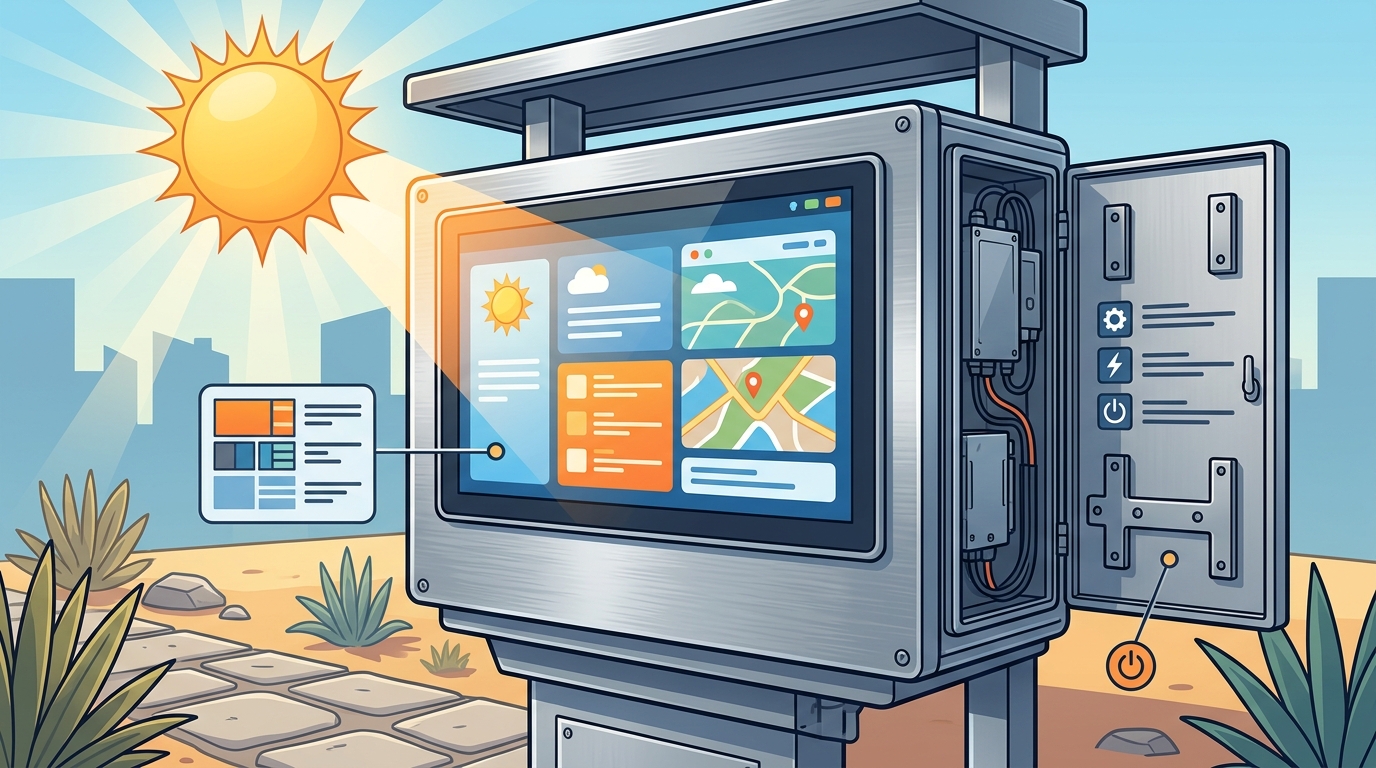
Waterproofing and Environmental Protection
Outdoor kiosks are exposed to rain, snow, sleet, and humidity. Therefore, the display must have a high Ingress Protection (IP) rating. IP ratings are an internationally accepted standard that classifies the degree of protection provided by enclosures against intrusion of dust and water. The first number refers to protection against solids, and the second number refers to protection against liquids.
For outdoor applications, an IP65 or IP66 rating is the minimum requirement. IP65 indicates total protection against dust and protection against low-pressure water jets from any direction. IP66 offers protection against powerful water jets. Tru-Vu provides NEMA 4X waterproof monitors, which are equivalent to IP66 or higher. These enclosures are typically constructed from stainless steel or aluminum to prevent corrosion. For wash-down environments, such as food processing or car washes, IP68-rated displays may be necessary, offering protection against continuous immersion.
Thermal Management in Outdoor Enclosures
Waterproof enclosures trap heat, which can damage the LCD panel if not managed correctly. Industrial displays incorporate passive cooling designs or active thermal management systems to maintain optimal operating temperatures. Tru-Vu monitors are designed to operate in wide temperature ranges, often from -40°F to +185°F. This ensures that the display remains functional in both freezing winter conditions and hot summer sun.
Touchscreen Technologies for Outdoor Use
Interactive kiosks require a reliable touchscreen interface. There are several technologies available, each with distinct advantages for outdoor use. The most common options are resistive, projected capacitive (P-Cap), and infrared (IR) touchscreens.
Projected capacitive (P-Cap) touchscreens are the industry standard for high-end outdoor kiosks. P-Cap technology is is a capacitive touch interface that detects the electrical charge of a human finger. It offers high clarity, multi-touch capabilities, and durability. P-Cap screens can be operated with bare fingers or gloves, making them ideal for public use. Resistive touchscreens, while cheaper, have lower image clarity and are less durable. Infrared touchscreens use a grid of beams around the screen edge and are highly durable but can be obstructed by dirt or debris.
Choosing the Right Touch Technology
For a premium outdoor kiosk, a P-Cap touchscreen with optical bonding is the recommended configuration. This combination provides the best balance of visibility, durability, and user experience. Tru-Vu offers P-Cap touchscreens on a wide range of sunlight-readable monitors, from 15.6 inches to 55 inches. The touch layer is integrated into the optically bonded assembly, ensuring that the touch surface is as durable as the display itself.
Mounting and Integration Options
Proper mounting is critical for the longevity and security of an outdoor kiosk display. VESA mounting is the standard interface for attaching displays to brackets, arms, or kiosk enclosures. VESA mounting is a standardized mounting interface defined by the Video Electronics Standards Association, ensuring compatibility between displays and mounting hardware. Most industrial monitors include VESA holes (75x75mm, 100x100mm, or 200x200mm) on the rear of the unit.
For outdoor installations, corrosion-resistant mounting brackets are essential. Tru-Vu provides a range of outdoor monitor mounts, including wall mounts, articulating arms, and portrait mode brackets. These brackets are designed to withstand wind loads and environmental exposure. Additionally, panel-mount monitors are available for flush installation into kiosk cabinets or walls, providing a sleek, integrated look while protecting the electronics from tampering.
Power Considerations
Outdoor kiosks may be powered by standard AC power or DC power, depending on the location. Many industrial applications use 24VDC power to improve operator safety and reduce installation complexity. Tru-Vu offers monitors that can be configured to operate on 12VDC, 24VDC, or 9-36VDC power supplies. This flexibility allows for easier integration into existing kiosk power systems, particularly in mobile or remote locations.
Display Configuration Comparison
The following table summarizes the key differences between consumer-grade and industrial-grade displays for outdoor kiosk applications.
| Feature | Consumer-Grade Monitor | Industrial-Grade Sunlight-Readable Monitor |
|---|---|---|
| Brightness | 250-300 nits | 1,000-2,500 nits |
| Waterproofing | None | IP65, IP66, or IP68 |
| Operating Temperature | 32°F to 104°F | -40°F to +185°F |
| Optical Bonding | Not available | Available (reduces reflections by 90%) |
| Touch Technology | Basic Capacitive | P-Cap, Resistive, or IR |
| Operating Life | 3-5 years | 7-10 years |
| Warranty | 1 year | 3 years |
Key Takeaways
- Sunlight-readable monitors require a minimum of 1,000 nits brightness for indirect sunlight and 2,000+ nits for direct sunlight.
- Optical bonding is essential for outdoor displays as it reduces internal reflections and improves contrast.
- IP65 or IP66 waterproofing is the minimum standard for outdoor kiosks exposed to rain and snow.
- Projected capacitive (P-Cap) touchscreens offer the best balance of durability and user experience for outdoor kiosks.
- Industrial monitors are designed for 24/7 operation and have a typical lifespan of 7 to 10 years.
- VESA mounting and corrosion-resistant brackets are critical for secure outdoor installation.
- 24VDC power options improve safety and simplify installation in many kiosk environments.
- Tru-Vu Monitors provides a wide range of customizable, TAA-compliant industrial displays for outdoor applications.
Frequently Asked Questions
What is the minimum brightness required for an outdoor kiosk display?
For indirect sunlight or shaded areas, a display with 1,000 nits brightness is sufficient. For direct, unshaded sunlight, a display with 2,000 to 2,500 nits is recommended to ensure visibility.
What does IP66 rating mean for an outdoor monitor?
IP66 indicates that the enclosure is totally protected against dust and protected against powerful water jets from any direction. This is suitable for most outdoor kiosk applications.
Can I use a consumer-grade monitor for an outdoor kiosk?
No. Consumer-grade monitors are not designed for outdoor use. They lack waterproofing, have insufficient brightness, and will fail quickly due to heat and moisture exposure.
What is optical bonding and why is it important?
Optical bonding is the process of bonding a protective glass layer to the LCD panel. It eliminates the air gap, reducing reflections by up to 90% and improving visibility in bright light.
How long do industrial outdoor monitors last?
Industrial-grade monitors are designed for 24/7 operation and typically have a lifespan of 7 to 10 years, significantly longer than consumer-grade models.
Does Tru-Vu offer custom outdoor kiosk displays?
Yes. Tru-Vu provides custom and modified industrial monitors, including private labeling, specific power requirements, and custom enclosures to meet your project specifications.
Conclusion
Securing a reliable sunlight-readable monitor for your outdoor kiosk requires careful consideration of brightness, waterproofing, and durability. By choosing an industrial-grade display from a specialized manufacturer, you ensure long-term reliability and optimal visibility in any weather condition. Tru-Vu Monitors offers a comprehensive range of rugged, TAA-compliant displays and touch screens designed specifically for these demanding environments. To find the perfect display for your kiosk project, contact our monitor specialists for a consultation and quote.