
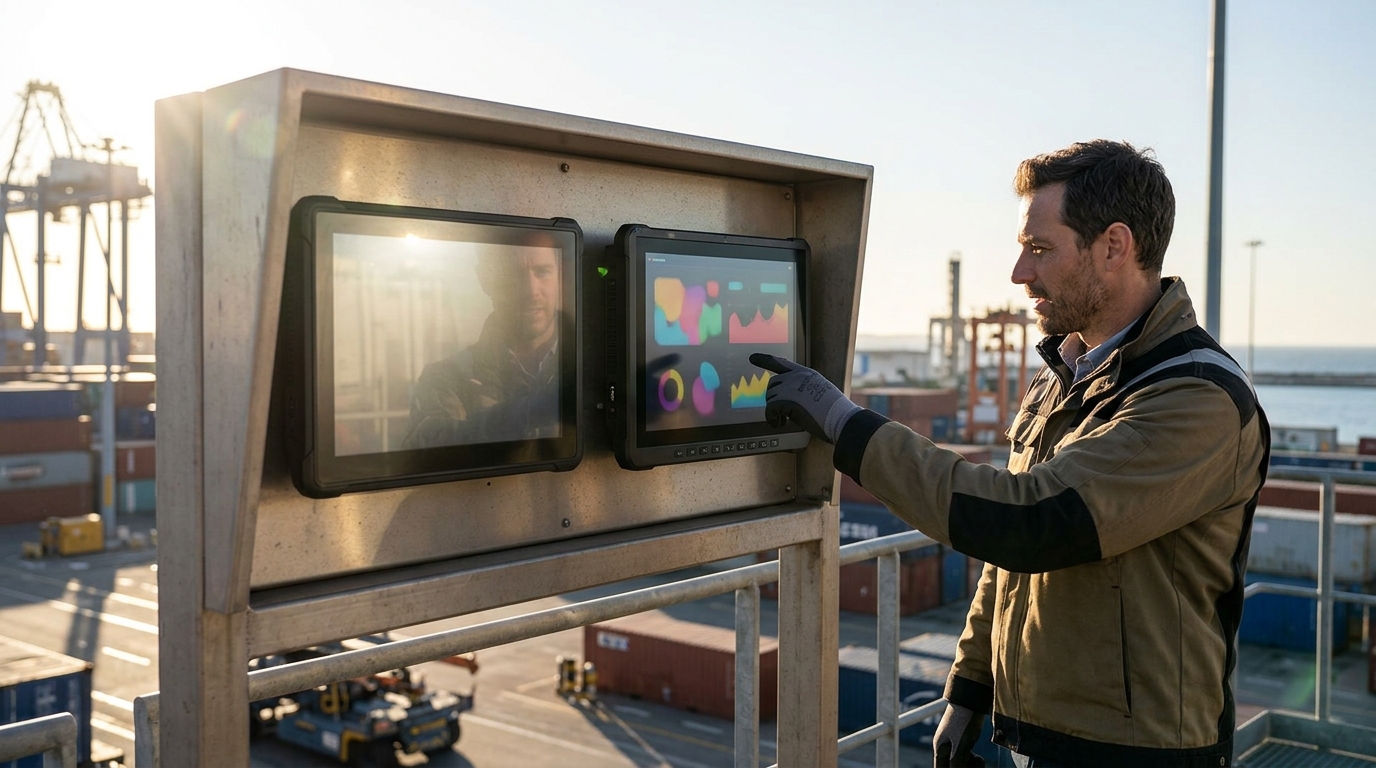
Standard monitors typically output 250 to 300 nits, making them unreadable in bright daylight. Sunlight-readable monitors use high-brightness backlights and optical bonding to reach 1,000 to 2,500 nits. This guide explains the technical differences, environmental requirements, and selection criteria for industrial displays. We cover brightness standards, optical bonding, and durability factors for Tru-Vu Monitors.
Understanding Brightness and Nits
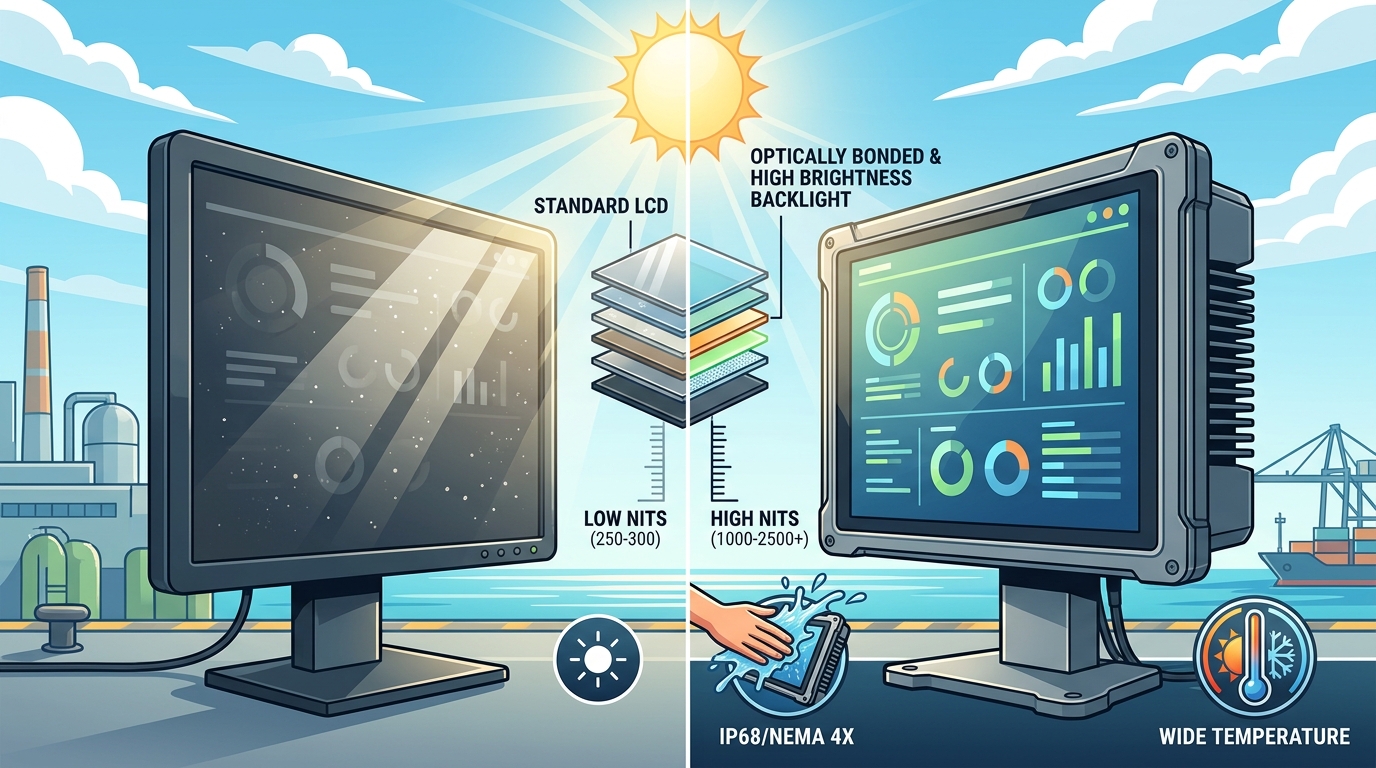
Brightness is measured in nits, which is a unit of luminance equivalent to candela per square meter. A standard consumer monitor is designed for indoor use and typically produces between 250 and 300 nits. This level of output is sufficient for office environments with controlled lighting. However, it fails completely when exposed to direct sunlight or bright outdoor conditions.
Sunlight-readable monitors are engineered to overcome this limitation. These displays utilize high-brightness LED backlights that can output between 1,000 and 2,500 nits. This significant increase in luminance allows the image to compete with ambient light. Tru-Vu Monitors offers a wide range of sunlight-readable displays designed specifically for these demanding environments. The higher the nit count, the more visible the content remains in harsh conditions.
Why Standard Monitors Fail Outdoors
Standard LCD panels rely on a backlight that is easily overwhelmed by external light sources. When ambient light exceeds the panel's luminance, the contrast ratio drops to near zero. This results in a washed-out, gray screen that is impossible to read. The physics of light reflection and transmission dictate that a display must be significantly brighter than its surroundings to maintain visibility.
Choosing the Right Brightness Level
Selecting the correct brightness depends on the specific installation location. Indirect sunlight or shaded outdoor areas may require 1,000 to 1,500 nits. Direct, unshaded sunlight typically demands 2,000 to 2,500 nits. Tru-Vu provides models across this entire spectrum to match your specific environmental needs. Consulting with a specialist ensures you do not over-specify or under-specify the display.
The Role of Optical Bonding
Optical bonding is a process that permanently attaches a protective glass layer to the LCD panel using a clear adhesive. This technique eliminates the air gap that exists in standard monitor assemblies. By removing this gap, optical bonding significantly reduces internal reflections and glare. The result is a sharper, higher-contrast image that remains legible in bright light.
In standard monitors, light reflects off the multiple surfaces within the display stack. These reflections create a hazy overlay that reduces image clarity. Optical bonding replaces the air with a resin that has a refractive index similar to glass. This allows light to pass through with minimal reflection. Tru-Vu offers optically bonded monitors that provide superior visibility and durability. This technology is critical for any display intended for outdoor or high-glare environments.
Benefits of Optical Bonding
Optical bonding improves contrast ratio by eliminating internal reflections. It also increases the structural integrity of the display assembly. The bonded glass and panel act as a single unit, providing better resistance to shock and vibration. Additionally, the sealed assembly prevents moisture and dust from entering the display. This makes optically bonded monitors ideal for industrial and outdoor applications.
Durability and Environmental Protection
Sunlight-readable monitors are not just brighter; they are built to withstand harsher conditions. Standard consumer monitors use plastic enclosures that degrade under UV exposure and temperature fluctuations. Industrial sunlight-readable displays use rugged materials like stainless steel, aluminum, or painted steel. These materials resist corrosion, impact, and extreme temperatures.
Environmental protection is measured using IP (Ingress Protection) and NEMA ratings. An IP65 rating protects against dust and water jets, while NEMA 4X provides protection against corrosion and water. Tru-Vu manufactures NEMA 4X waterproof monitors that are fully sealed against the elements. These displays can operate in rain, snow, and direct sunlight without failure. The combination of high brightness and rugged construction defines a true sunlight-readable industrial monitor.
Temperature and Vibration Resistance
Outdoor environments expose displays to extreme temperature swings. Standard monitors are designed for climate-controlled rooms and may fail in freezing or hot conditions. Industrial monitors feature wide-temperature operating ranges, often from -40°F to +185°F. They also include shock and vibration resistance to handle mobile or heavy equipment applications. This durability ensures long-term reliability in the field.
Standard vs Sunlight-Readable Comparison
The table below summarizes the key differences between standard consumer monitors and industrial sunlight-readable displays. This reference helps you quickly identify the features required for your specific application.
| Feature | Standard Monitor | Sunlight-Readable Monitor |
|---|---|---|
| Brightness | 250 - 300 nits | 1,000 - 2,500 nits |
| Optical Bonding | Not included | Standard or optional |
| Enclosure Material | Plastic | Steel, Aluminum, Stainless |
| Water Resistance | None | IP65 to IP68 / NEMA 4X |
| Operating Temperature | 32°F to 104°F | -40°F to +185°F |
| Intended Use | Indoor / Office | Outdoor / Industrial |
This comparison highlights why standard monitors are unsuitable for outdoor digital signage or industrial control panels. The industrial-grade features of sunlight-readable displays ensure performance and longevity in challenging settings.
Key Takeaways
- Standard monitors output 250-300 nits, which is insufficient for outdoor visibility.
- Sunlight-readable monitors range from 1,000 to 2,500 nits to compete with daylight.
- Optical bonding eliminates air gaps, reducing glare and improving contrast.
- Industrial displays use rugged enclosures like steel and aluminum for durability.
- Waterproof ratings like IP65 and NEMA 4X protect against rain and dust.
- Wide-temperature operation ensures reliability in extreme climates.
- Tru-Vu Monitors provides custom and off-the-shelf solutions for these needs.
Frequently Asked Questions
What is the minimum brightness for a sunlight-readable monitor?
A monitor is generally considered sunlight-readable if it outputs at least 1,000 nits. For direct, unshaded sunlight, 2,000 to 2,500 nits is recommended to ensure clear visibility.
Does optical bonding improve brightness?
Optical bonding does not increase the raw backlight brightness. However, it significantly improves perceived brightness and contrast by eliminating internal reflections and glare.
Can a standard monitor be modified to be sunlight-readable?
It is not practical to modify a standard consumer monitor. The backlight, panel, and enclosure are not designed for high brightness or environmental protection. You must purchase a dedicated industrial display.
What is the difference between IP65 and NEMA 4X?
IP65 protects against dust and low-pressure water jets. NEMA 4X provides protection against corrosion and water, including heavy rain and sleet. NEMA 4X is generally more robust for outdoor use.
Are sunlight-readable monitors more expensive?
Yes, they are typically more expensive than standard monitors due to the high-brightness backlight, rugged enclosure, and specialized components. However, they offer a longer lifespan and reliability in harsh environments.
Where can I find a supplier for industrial sunlight-readable monitors?
Tru-Vu Monitors offers a wide selection of sunlight-readable and waterproof displays. You can to discuss your specific application requirements.
Conclusion
Choosing between a standard and a sunlight-readable monitor depends entirely on your operating environment. Standard monitors are cost-effective for indoor use but fail in bright light. Sunlight-readable monitors provide the necessary brightness, durability, and protection for outdoor and industrial applications. By understanding the role of nits, optical bonding, and environmental ratings, you can select the right display for your project. Tru-Vu Monitors provides expert guidance and a comprehensive range of rugged displays to meet your specific needs. Contact Tru-Vu Monitors today to find the perfect solution for your application.