

Manufacturers like TRU-Vu Monitors modify standard industrial displays to custom specifications at low volumes, offering private labeling and bespoke engineering without the massive minimum order quantities required by large-scale Asian factories. This guide covers the capabilities of OEM and ODM partners, the technical modifications available for rugged displays, and how to navigate the procurement process for specialized, low-volume industrial monitor projects.
OEM and ODM Customization Capabilities
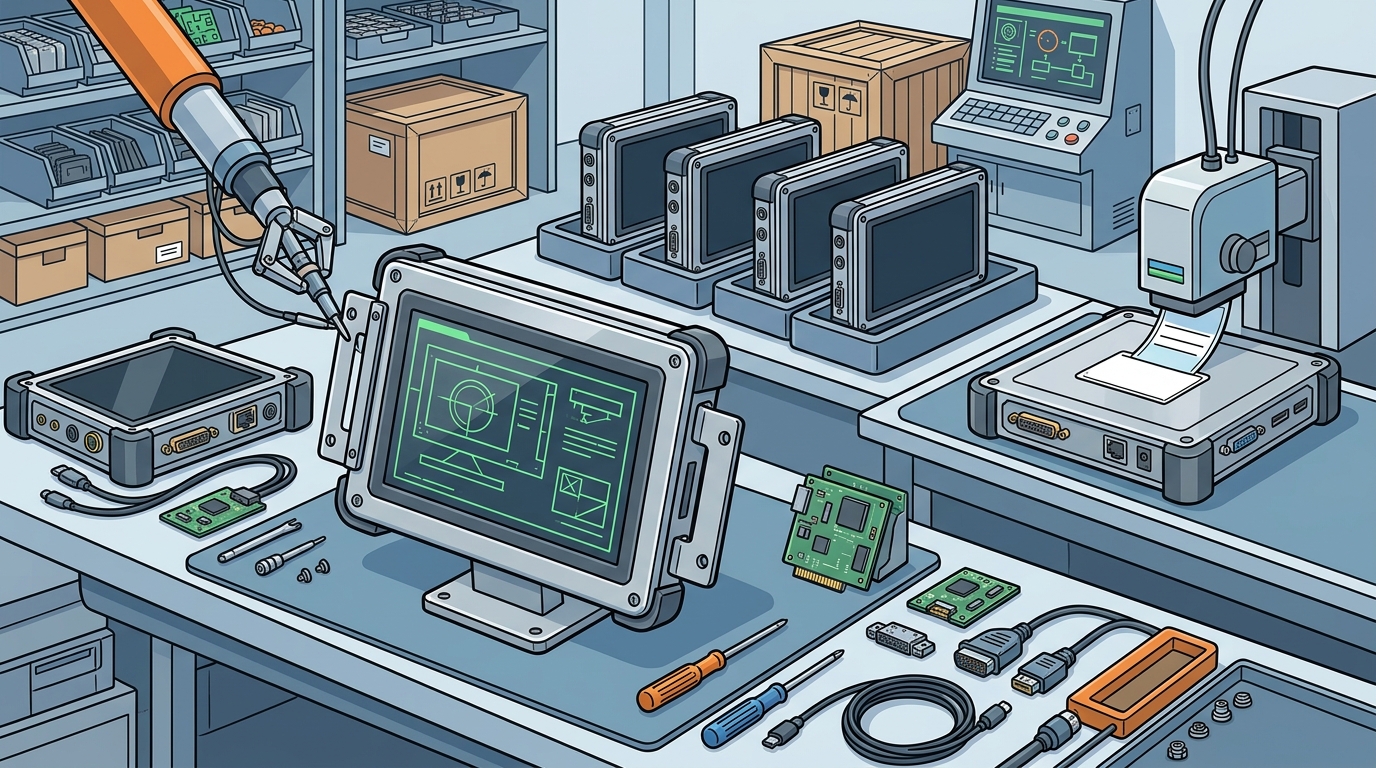
Understanding the difference between Original Equipment Manufacturing (OEM) and Original Design Manufacturing (ODM) is the first step in securing a custom display. OEM is a business model where a manufacturer produces components or finished goods that are branded and sold by another company. In the industrial display sector, this often involves taking a standard, off-the-shelf monitor and applying a client's logo, model number, and specific hardware modifications. ODM is a process where the manufacturer designs and builds the product from the ground up based on the client's specifications, often resulting in a unique product that no other company can order.
For low-volume projects, the distinction is critical. Large-scale manufacturers typically require high minimum order quantities (MOQs) for ODM projects because the initial tooling and engineering costs are amortized over thousands of units. In contrast, specialized industrial display providers like TRU-Vu Monitors are designed to handle low-volume OEM and ODM requests. They can modify existing stock units or build custom units in small batches, making it feasible for startups, specialized integrators, and niche industrial applications to get a branded, spec-specific display without committing to a massive inventory.
Private Labeling and Branding
Private labeling is the most common form of low-volume customization. It involves applying the client's corporate identity to the monitor. This includes silk-screening the company logo onto the front bezel and printing a unique, exclusive model number on the rear label. This ensures that the product is recognized as the client's proprietary asset. For systems integrators, this branding is essential for maintaining a cohesive look across their entire product line, whether they are building medical carts, kiosks, or heavy equipment control panels.
Hardware and Interface Customization
Beyond branding, manufacturers can modify the physical hardware of the monitor. This includes changing the video inputs (such as adding BNC, HD-SDI, or DisplayPort), altering the power requirements (converting to 12VDC, 24VDC, or 9-36VDC for mobile applications), and changing the enclosure material. For example, a standard ABS plastic monitor can be modified to use a stainless steel or aluminum enclosure for enhanced durability in marine or food processing environments. These modifications allow the monitor to fit precisely into the client's existing chassis or control box.
Low-Volume Procurement and Minimum Order Quantities
The primary barrier to custom displays is the minimum order quantity. Traditional consumer electronics manufacturers often require orders of 1,000 to 10,000 units to justify the production line setup. For industrial applications, however, demand is often fragmented. A specific model of crane monitor or a specialized medical display might only need 50 to 200 units per year. Manufacturers who specialize in the industrial niche, such as TRU-Vu Monitors, are equipped to handle these low-volume runs. They maintain inventory of standard panels and components, allowing them to assemble custom units quickly without the long lead times associated with mass production.
When evaluating a manufacturer for low-volume customization, it is essential to ask about their inventory strategy. Do they keep the specific LCD panels in stock? Can they source the necessary connectors and power supplies quickly? A manufacturer with a robust inventory of industrial-grade components can turn around a low-volume custom order in weeks rather than months. This agility is a significant advantage over large-scale factories that must order raw materials in bulk and wait for global shipping schedules.
Cost Implications of Low-Volume Orders
It is a common misconception that custom monitors are significantly more expensive than off-the-shelf models. In many cases, the cost of a modified or custom-built monitor is comparable to the price of a standard unit. The additional cost is often minimal because the manufacturer is simply reconfiguring existing components. However, for true ODM projects involving new enclosure designs or unique electronic boards, there may be non-recurring engineering (NRE) costs. These costs are spread across the low-volume order, which can increase the per-unit price. It is crucial to get a detailed quote that breaks down NRE costs from per-unit costs to understand the total investment.
Technical Modifications and Engineering
Industrial monitors are not just about size and resolution; they are about surviving harsh environments. Customization often involves enhancing the monitor's ability to handle extreme conditions. This includes modifying the operating temperature range, adding optical bonding to improve visibility in bright light, and implementing specific ingress protection (IP) ratings for dust and water resistance.
Optical Bonding and Sunlight Readability
Optical bonding is the process of permanently bonding a protective glass or touchscreen layer directly to the front surface of an LCD using a clear optical-grade adhesive. This eliminates the air gap traditionally found between the display and cover glass. Without optical bonding, ambient light can reflect off multiple surfaces within the display assembly, creating glare and reducing image clarity. Optical bonding minimizes these reflections, resulting in a brighter, sharper, and easier-to-read image. For outdoor applications, this is often combined with high-brightness backlighting, ranging from 1,000 to 2,500 nits, to ensure visibility in direct sunlight.
Enclosure and Ingress Protection
The enclosure is the first line of defense against environmental hazards. Custom enclosures can be designed to meet specific NEMA or IP ratings. For example, a NEMA 4X rating provides protection against water jets and corrosion, making it ideal for outdoor signage or wash-down environments in food processing plants. Manufacturers can modify standard enclosures to add these ratings or build entirely new enclosures from materials like stainless steel or aluminum. This ensures that the monitor can withstand the specific challenges of its deployment environment, whether it is a dusty construction site or a humid marine vessel.
Touchscreen Technology Selection
Choosing the right touchscreen technology is a critical part of customization. Projected capacitive (P-Cap) touchscreens are the industry standard for high-end applications due to their multi-touch capabilities and durability. However, for industrial environments where users may wear gloves or where the screen is exposed to harsh chemicals, resistive or surface capacitive touchscreens may be more appropriate. Manufacturers can customize the touch interface to match the specific interaction model of the application, ensuring that the user experience is both intuitive and reliable.
Compliance, Certification, and Long-Term Availability
One of the most significant advantages of working with a specialized industrial monitor manufacturer is long-term availability. Consumer-grade monitors are typically discontinued within 6 to 18 months, which is unacceptable for industrial applications that require a 5 to 10-year lifespan. Industrial manufacturers commit to long-term model availability, often guaranteeing that a specific model will be available for 3 to 5 years or more. This is crucial for OEMs who need to ensure that spare parts are available for the lifetime of their product.
Regulatory Compliance and Standards
Industrial monitors must comply with a variety of regulatory standards, depending on the application and region. For medical applications, monitors must be certified to UL 60601-1 and IEC 60601-1 standards, which ensure electrical safety and electromagnetic compatibility. For government and defense applications, monitors must be TAA (Trade Agreements Act) compliant, meaning they are manufactured in the United States or in a free trade country. Manufacturers like TRU-Vu Monitors provide TAA-compliant and NDAA-compliant displays, ensuring that they can be used in sensitive government projects. Understanding these compliance requirements is essential when selecting a manufacturer for a custom display.
Warranty and Support
Custom monitors come with specific warranty terms that reflect their industrial-grade construction. Most industrial monitors are backed by a 3-year warranty, which is significantly longer than the 1-year warranty typical of consumer displays. This warranty covers defects in workmanship and materials, providing peace of mind for the end user. Additionally, specialized manufacturers offer robust technical support and repair services, ensuring that any issues are resolved quickly to minimize downtime. This level of support is a key differentiator when choosing a manufacturer for a critical industrial application.
Comparison of Customization Options
| Feature | Standard Off-the-Shelf | Modified OEM | Custom ODM |
|---|---|---|---|
| Minimum Order Quantity | 1 Unit | Low (10-50 Units) | Medium (50-100+ Units) |
| Branding | Manufacturer Brand | Client Logo/Model Number | Client Logo/Model Number |
| Hardware Modifications | None | Inputs, Power, Enclosure | Full Custom Design |
| Lead Time | 1-2 Weeks | 4-8 Weeks | 8-12+ Weeks |
| Long-Term Availability | 6-18 Months | 3-5 Years | 5+ Years |
Key Takeaways
- OEM vs. ODM: OEM involves modifying existing products with client branding, while ODM involves designing a new product from scratch. Both are viable for low-volume industrial projects.
- Low-Volume Feasibility: Specialized industrial manufacturers can handle low-volume orders (10-100 units) without the high MOQs required by mass-market factories.
- Cost Parity: Modified monitors are often priced similarly to off-the-shelf models, making customization a cost-effective option for niche applications.
- Environmental Hardening: Customization allows for specific environmental protections, such as optical bonding, high brightness, and NEMA/IP-rated enclosures.
- Long-Term Availability: Industrial manufacturers guarantee long-term model availability (3-5+ years), which is critical for OEMs and integrators.
- Compliance: Ensure the manufacturer offers TAA, NDAA, or medical-grade certifications if required for your specific industry or region.
- Technical Support: Choose a manufacturer that offers robust technical support and repair services to minimize downtime for critical applications.
Frequently Asked Questions
What is the typical minimum order quantity for custom industrial monitors?
For modified OEM monitors, the minimum order quantity is often as low as 10 to 50 units. For true ODM projects involving new enclosure designs, the MOQ may be higher, typically 50 to 100 units, to justify the non-recurring engineering costs.
How long does it take to produce a custom industrial monitor?
Lead times vary depending on the complexity of the customization. Modified OEM units can typically be produced in 4 to 8 weeks. Custom ODM projects may take 8 to 12 weeks or more, depending on the design and tooling requirements.
Can I get a custom monitor with a specific power requirement, like 24VDC?
Yes, most industrial monitor manufacturers can modify standard monitors to operate on 12VDC, 24VDC, or 9-36VDC power supplies. This is a common customization for mobile and heavy equipment applications.
What is the difference between a NEMA 4X and an IP65 rating?
NEMA 4X is a North American standard that provides protection against water jets and corrosion. IP65 is an international standard that provides protection against dust and low-pressure water jets. Both are suitable for outdoor and wash-down environments, but NEMA 4X is often preferred in North American industrial applications.
Are custom monitors more expensive than standard models?
Not necessarily. Modified OEM monitors are often priced similarly to off-the-shelf models. The additional cost is usually minimal because the manufacturer is reconfiguring existing components. True ODM projects may have higher per-unit costs due to non-recurring engineering fees.
Do custom monitors come with a warranty?
Yes, most industrial monitors, including custom models, come with a 3-year warranty. This warranty covers defects in workmanship and materials, providing peace of mind for the end user.
Can I use a custom monitor in a medical application?
Yes, but the monitor must be certified to UL 60601-1 and IEC 60601-1 standards. Manufacturers like TRU-Vu Monitors offer medical-grade displays that meet these requirements, ensuring safety and reliability in healthcare environments.
Conclusion
Securing a custom industrial monitor for a low-volume project requires a partner that understands the nuances of OEM and ODM manufacturing. While large-scale factories may offer lower per-unit prices, they often impose high minimum order quantities and long lead times that are impractical for niche applications. Specialized manufacturers like TRU-Vu Monitors provide the flexibility, technical expertise, and long-term availability needed to bring a custom display to market. By leveraging their capabilities in private labeling, hardware modification, and environmental hardening, you can create a display that perfectly fits your application's requirements. To discuss your specific customization needs, for a detailed consultation and quote.